When it comes to humanoid robots, what comes to your mind first?
Is it the "T-800" from the movie "Terminator", or the "replicant" from "Blade Runner 2049"? Judging from the vivid portrayal of the "bionic human" concept in the movies, they not only have lifelike appearances but also possess remarkable mobility.

Not only in film and television works, but also in the video of Tesla's Optimus-Gen2 released on December 12, 2023, the significant progress in the mobility of its humanoid robots was demonstrated.
"Stacking clothes, doing 90-degree squats, doing yoga, cracking eggs..." Optimus-Gen2 can effortlessly perform all these smooth and fluid movements. While we are marveling at the rapid development of humanoid robots, why not join me in learning about the technical support behind these smooth operations?

In fact, it is the six-dimensional force sensor that provides the robot with functions similar to human touch, enabling the robot to sense and adapt to changes in the external environment, thereby completing more complex and delicate tasks. It is the core component of the robot's compliant control and operation.
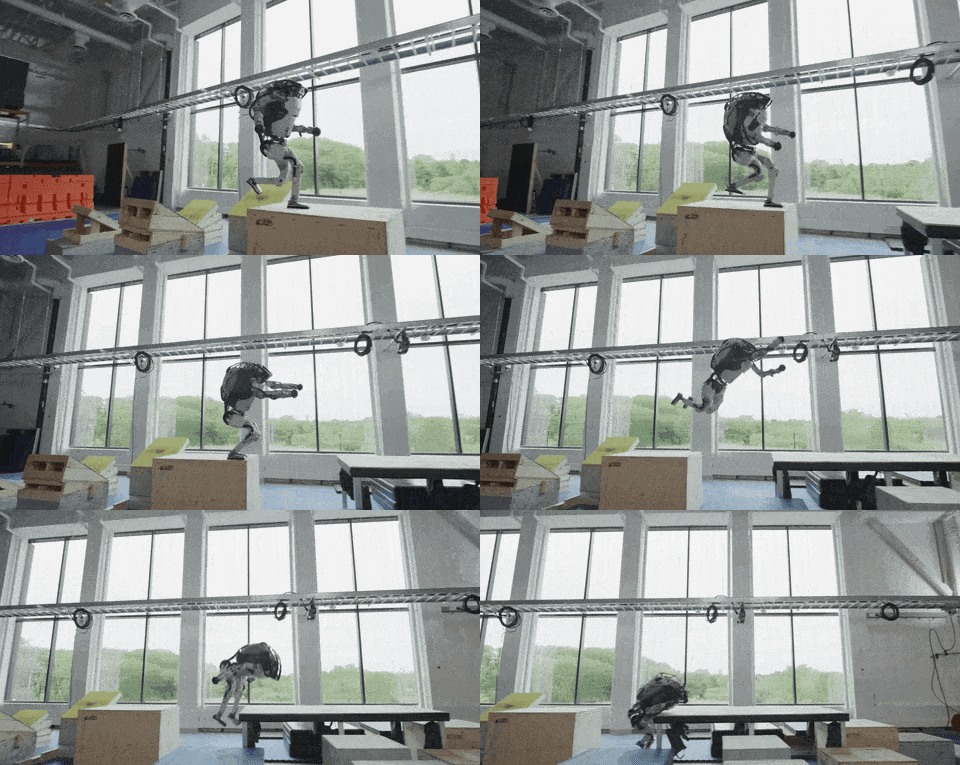
The six-dimensional force sensor is usually installed on the wrist, ankle, sole of the foot or hand. It plays a crucial role in operation control planning, posture adjustment, and force perception, enhancing the flexibility of hand operations and the stability of foot walking, improving the autonomy and adaptability of humanoid robots in complex environments. It enables stable and rapid walking on uneven ground such as gravel, tiles, lawns, thick soil, and lawns, through a new sole posture control algorithm and flexible adaptive to various surfaces.
At present, the demand for soft control of robots is growing rapidly. The six-dimensional force sensor is a type of sensor with high precision, and it is precisely this demand that is the key to realization. It is also the core factor determining whether humanoid robots and other embodied intelligent products can be smoothly applied in practice.
01. What is a six-dimensional force sensor?
The six-dimensional force sensor is a special force-sensing device that can measure the forces and torques in three axes of an object in the Cartesian coordinate system. Its interior is equipped with highly sensitive materials and precise mechanical structures, which can provide higher measurement accuracy for robotic arms and meet the measurement requirements in various scenarios.
As a key device for the mechanical arm to perceive the external environment, the six-dimensional force sensor is usually installed between the end effector of the mechanical arm and the mechanical arm itself. It is used to detect the multi-dimensional interaction forces/torques between the robot and the environment during operation, and to feed back these interaction forces/torques to the mechanical force control system. This can significantly enhance the assembly advantages of the mechanical arm.
According to the measurement dimensions, force sensors can be classified into one to six-dimensional force sensors. Within the specified Cartesian coordinate system, if the sensor can simultaneously measure the forces along the three coordinate axes and the torques around the three coordinate axes, such force sensors are referred to as six-dimensional force sensors or six-axis force sensors.
02. Specific Applications of Six-Dimensional Force Sensors in Robots
Wrist area: Six-dimensional force sensors are installed at the wrist area, which can help the robot perform precise hand operations such as grasping, transporting, and assembling tasks.
Ankle and sole: Installing six-dimensional force sensors at the ankle or sole of the foot helps the robot perceive the reactive force of the ground during walking and balance control. This enables the robot control system to adjust the posture of the humanoid robot's arms and body, thereby improving the walking stability.
Hand contact points: Installing six-dimensional force sensors at the contact points of the robot's hand can enhance the flexibility and adaptability of hand operations, especially in scenarios requiring soft control.
Operation Control Planning: The data provided by the six-dimensional force sensor is of vital importance for the motion control planning of the robot. They can help the robot better plan its movements and avoid collisions and damages.
Posture adjustment: During the posture adjustment process of the robot, the six-dimensional force sensor can provide the necessary feedback information to help the robot maintain balance and stability.
Force sensing: The six-dimensional force sensor enables the robot to sense the force when interacting with external objects, which is extremely important for applications that require precise control of force.
From the above, it can be concluded that the six-dimensional force sensor has become a standard component for high-performance humanoid robots.
However, at present, the technical barriers for multi-dimensional torque sensors are quite high, and the leading enterprises in the US and Japan have a significant first-mover advantage. In China, the industry is still in its early stage. Due to the high technical barriers, there are relatively few enterprises capable of mass production in China.
03. Dessen's Multi-dimensional Force Sensor
In response to the current situation of this industry, some domestic enterprises have made corresponding efforts. Densent Sensor, based on the current market demand for six-dimensional force sensors, started its research and production of six-dimensional force products in 2018. So far, it has successfully launched several high-end products suitable for various robotic arms and robots, such as DSDW-γ74, DSDW-γ45, and DSDW-γ82, which have received high praise from the market.
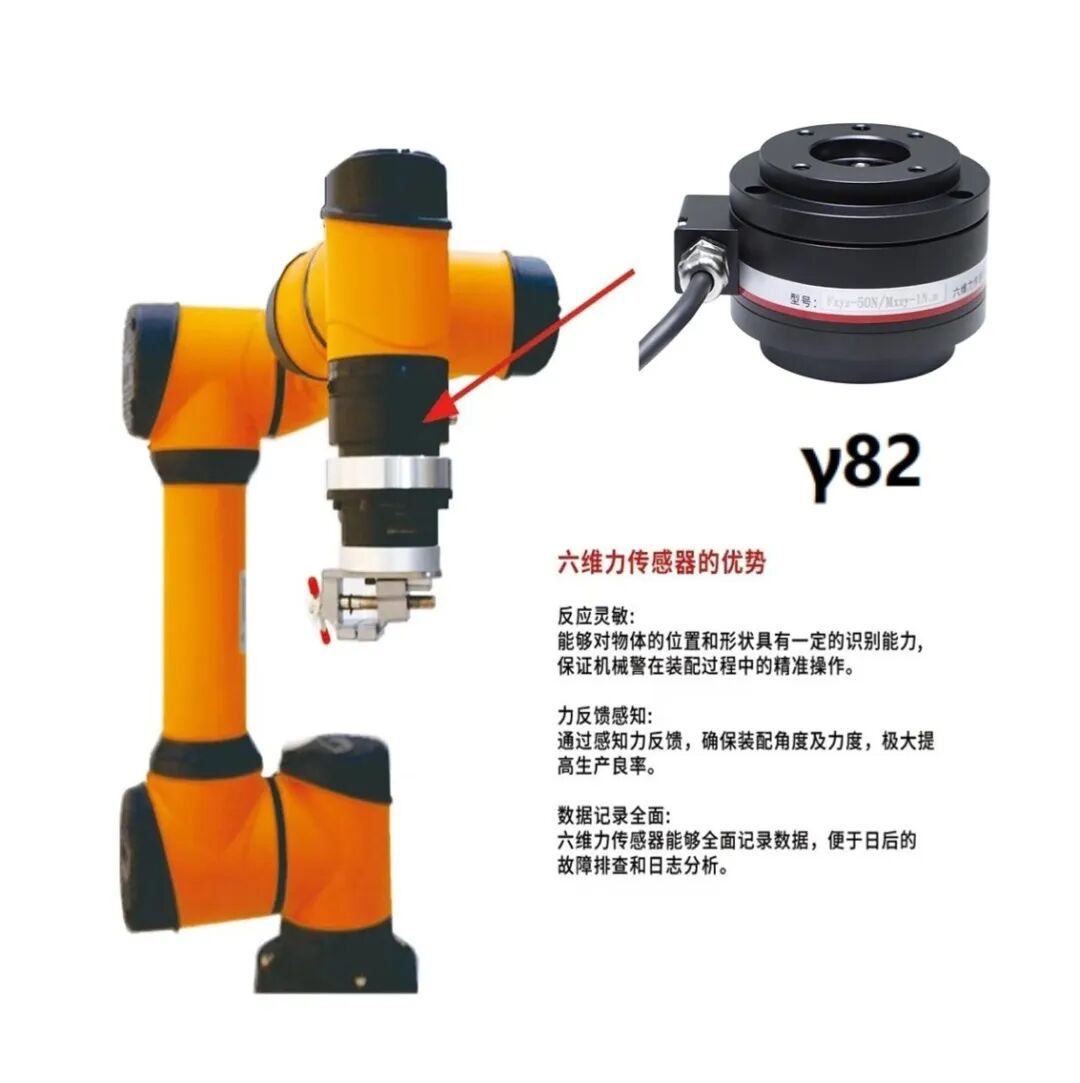
The six-dimensional force sensor developed and produced by Destent is made of aviation aluminum alloy and uses international high-level strain gauge chips. It can achieve high resolution, high response rate, and high test accuracy points. It has been carefully tested upon leaving the factory and has extremely high coupling accuracy. Multiple communication interface protocols can be selected, basically covering the mainstream interface of collaborative robots in both domestic and international markets. Debugging software or testing software can also be provided.


